The Senate’s Two Favorite Words Are Also Its Sharpest Knife
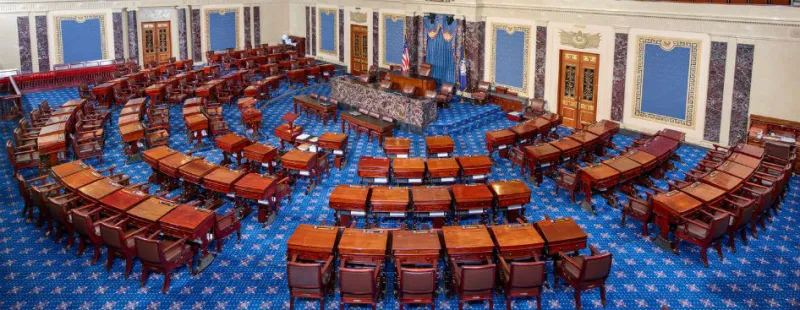
Photo: United States Senate, Public domain, via Wikimedia Commons
The most consequential thing that happens on the Senate floor on a given Tuesday is usually not a vote. It’s a sentence, spoken to a nearly empty room, that ends with the words “without objection.”
If you’ve ever flipped past C-SPAN at 6:40 p.m., seen three people and a presiding officer, and changed the channel, you flipped past the part where the laws get made.
What “without objection” actually means
Unanimous consent — UC, in the shorthand — is the Senate’s workhorse. The chair asks whether there is objection to a request, and silence means yes. That’s it. No roll call, no recorded votes, no campaign ad. Just the absence of someone saying no.
The catch is baked into the name. Any single senator can object. One. Not a majority, not a committee, not a party leader. One person, for any reason, or no stated reason at all. And because the whole chamber runs on this arrangement, roughly the entire noncontroversial business of the federal government moves through it: routine nominations, committee filings, land transfers, reauthorizations, the post-office renaming bloc.
The request itself is worth learning to hear, because it arrives as one long sentence. Something like: the Senate proceed to immediate consideration of a bill, the bill be read a third time and passed, and the motion to reconsider be considered made and laid upon the table. That entire bundle is a single ask. Object to any part, and all of it falls.
Holds are not in the rulebook
There is no rule that says a senator may place a hold. It’s a courtesy. A senator tells their party leader, quietly, that they’d object if the bill came up. The leader treats it as a promise and keeps the bill off the floor.
For most of Senate history, these were genuinely anonymous. A 2007 ethics law required public disclosure after six session days, and the practice adapted without dying. Now a hold is disclosed in a bland entry in the Congressional Record, occasionally with a memo attached, and the bill settles into the calendar like sediment.
The objection doesn’t need a floor speech. It doesn’t need a reason you’d find persuasive. A hold is a stall, and a stall is enough, because the Senate’s scarcest resource is not votes — it’s floor time.
Why one objection can beat sixty votes
Here’s the math that runs the place. If a senator objects and refuses to relent, the majority has to break the filibuster to move the bill. That means a cloture motion, a couple of days of ripening, sixty votes, and then — under Rule XXII — up to thirty hours of post-cloture debate before anything else happens.
Thirty hours. For one bill. On a calendar that also has to confirm judges, fund the government, and pass an annual defense bill.
So leadership does the arithmetic that every majority leader has done for forty years: is this bill worth a week of the floor? Usually the answer is no. And that is how a bill with majority support and no organized opposition ends up exactly where it started, sitting at the desk, technically alive, practically furniture.
How to read the floor like a local
You don’t need a cloakroom source. You need to know five signals.
“Reserving the right to object.” Someone is about to explain why they’re blocking the thing they were just asked to allow. This is the polite version of a knife coming out.
“I object.” That’s the strike. Note who said it and what they cited. Those two details are the whole story.
Voice votes. “The ayes appear to have it.” That means nobody asked for a recorded vote, so there is no record of who voted which way. If you want to know how your senator stood, a voice vote tells you nothing — and that is a feature, not an accident.
The live quorum. A stall dressed as procedure. Time gets burned, the clock moves, and the schedule slips another day.
The hotline. The cloakroom’s informal check on whether anyone objects. It is not a vote. It is a survey of who’s willing to be difficult.
Where a bill dies in plain sight
Not on the floor. Bills almost never lose on the floor anymore; they stop being scheduled.
Watch three places. The Legislative Calendar and the Executive Calendar, where bills go to age. The daily Unanimous Consent section of the Congressional Record, where every request and objection is logged — that is the paper trail of everything that happened while nobody was watching. And the “held at the desk” designation, which is Senate for a bill that has been set aside without being set aside.
You can also count the days. A bill that sits on the calendar for two months with a disclosed hold and no cloture motion filed is not waiting for its moment. It’s waiting for a funeral.
A design choice, not a glitch
The Senate was built to make action hard and inaction easy. That protects small states and minority interests, and it also means the burden of proof always rests with whoever wants a vote. Which is why the most important vote in the Senate on any given day is frequently the one that never got called.
The next time the chamber looks empty, listen for two words. Somebody is deciding something.