The Most Powerful Person in the Senate Has Never Been on a Ballot
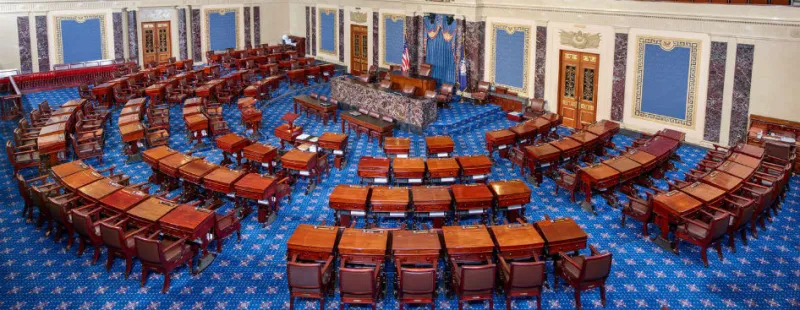
Photo: United States Senate, Public domain, via Wikimedia Commons
Somewhere in the Capitol, in an office that doesn't show up on the visitor map, a small staff keeps a running list of words. Incidental. Extraneous. Merely advisory. On a Tuesday afternoon, one of those words gets attached to a paragraph that a president campaigned on, and suddenly the most ambitious piece of legislation in a generation has a hole in it — a hole the size of a hospital wing or a tax bracket. Nobody voted on that. Nobody ran on it. And almost nobody will hear about it until the bill is already law or already dead.
That's the job of the Senate parliamentarian, the procedural referee whose rulings on budget reconciliation have a way of deciding what Congress is actually allowed to pass. If you've never heard the title, that's by design. The office thrives on being invisible — right up until the moment it isn't.
So what does the parliamentarian actually do?
Think of the parliamentarian as the Senate's in-house rules lawyer, minus the billable hours and with considerably more power. The office advises the presiding officer on procedure: whether an amendment is germane, whether a motion is in order, whether a bill can move without a cloture vote. Most of that work is mechanical and boring, the legislative equivalent of checking whether your carry-on fits the sizer.
Then there's reconciliation, where the boring stuff becomes the whole ballgame.
Reconciliation is the budget shortcut that lets the Senate pass certain fiscal measures with 51 votes instead of 60 — no filibuster, no weeks of floor wrangling. Both parties have used it, and both parties love it right up until the moment the parliamentarian says their favorite provision is out of bounds. Because reconciliation is a privileged process, it comes with strings: everything in the bill has to be genuinely budgetary, and it can't be what the Senate calls "extraneous." That's where the Byrd rule comes in, and where the parliamentarian turns from travel agent into judge.
The Byrd rule, explained without a flowchart
The Byrd rule — named for the late Senator Robert Byrd of West Virginia — is the guardrail that says a reconciliation bill can't carry provisions that are merely incidental to the budget. Sounds tidy. In practice, it's a swamp. Does a $15 minimum wage affect the federal budget? Sure, a little, in the way that a butterfly affects a hurricane. Is that enough? The parliamentarian said no in 2021, and a wage hike that had passed the House and had the president's blessing was gone from the Senate package before most voters had finished their coffee.
Same story in 2017, when the parliamentarian's rulings shaped what Republicans could cram into their health-care reconciliation effort and what had to be stripped out. Same story in 2025, when a sprawling tax-and-spending package got the once-over and staff on both sides spent days arguing about which provisions cleared the bar. The pattern is always the same: a bill is written with maximum ambition, then the parliamentarian's office issues guidance, then the ambition shrinks to fit.
And here's the part that should interest you: the ruling is a memo, not a Supreme Court decision. There's no oral argument, no amicus briefs, no televised reading of the opinion. Just language, parsing, and precedent handed down to a handful of staffers who then explain it to senators who probably won't read the whole thing.
Why both parties shrug in public and call at 11 p.m.
Officially, senators of both parties treat the parliamentarian with studied neutrality. They describe the office as a neutral arbiter, a keeper of Senate tradition, a nonpartisan resource. This is true. It is also a little bit of a performance.
Privately, everyone courts the referee. Staff prepare "Byrd rule" memos the way law students prepare for the bar exam. Committees tweak bill language to survive review. Lobbyists who know the office's habits start writing provisions in the style the parliamentarian tends to bless — shorter, budget-adjacent, less inclined to tell the government how to run a program. The office doesn't take meetings the way a senator does, but its fingerprints are all over the drafting of the bill you eventually hear about.
Every so often, someone threatens to overrule the referee. That's technically possible: the presiding officer can ignore the parliamentarian's advice, and 51 senators can sustain it. It happens rarely, because the moment you break the referee, you've broken the tool you'd want the next time you're in the majority. In 2021, when progressives pushed to override a ruling on the minimum wage, the Senate chose not to — a decision that spared the institution a fight it would have regretted.
The rulings nobody clips
The parliamentarian's rulings almost never make the evening news, and that's the point. By the time a provision is cut, the fight has usually moved on to a different headline: a floor vote, a press conference, a primary challenge. The missing provision becomes an absence, and absences don't trend.
So here's a modest proposal for the next time a big reconciliation bill is moving. Don't just watch the vote count. Watch the language changes in the days before the vote. Watch for the word "guidance" in a Hill story. Watch for committee staff suddenly saying a provision is "still being finalized" — that's often a euphemism for "the parliamentarian got to it." The referee rarely speaks. But the referee is always in the room.
That's not a knock on the office. It's a reminder that in a system built to slow things down, some of the most consequential decisions are made by people whose job is to make procedure harder to break. The Senate was designed for that kind of friction. The trouble is, friction is invisible right up until it stops the thing you wanted from happening.
And when it does, don't look for a speech. Look for a memo.