Your Phone's Emergency Alert Has a Chain of Command — and a Lot of Wiggle Room
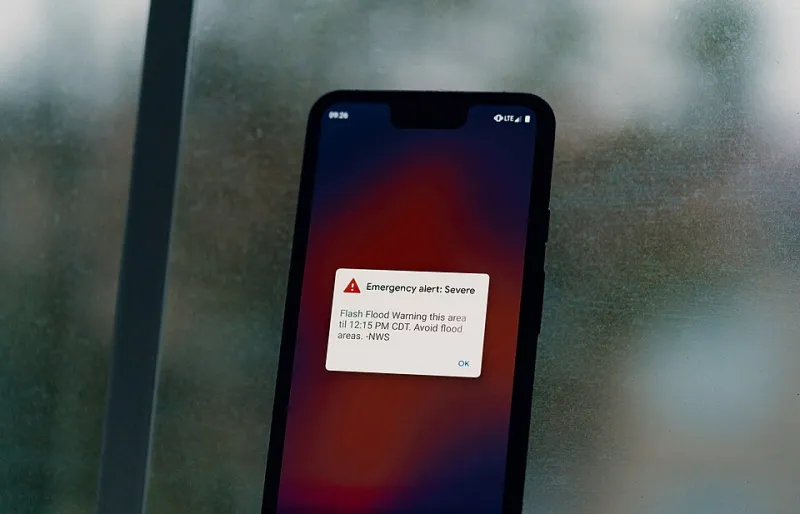
Photo: Tony Webster from Minneapolis, Minnesota, United States, CC BY 2.0, via Wikimedia Commons
Your phone does not care that you were asleep. At 2:13 a.m., it will scream — a jarring, static-laced buzzer that sounds like a fax machine having a panic attack. Maybe it's a tornado warning. Maybe it's an Amber Alert. Maybe it's a flash flood notice for a creek you've never heard of. Or maybe it's something else entirely, sent by a local official who decided your Tuesday needed a jolt.
That buzzer is the Wireless Emergency Alert system, or WEA. It's one of the most direct lines any government has to your eyeballs. And while it feels automatic — like the weather itself is texting you — every alert is the product of a chain of human decisions. The rules for who can pull that trigger, and what qualifies as an emergency, are looser than you might think. That looseness is the system's superpower and its vulnerability.
The Chain of Command (and Where It Gets Fuzzy)
The legal backbone is the Warning, Alert, and Response Network Act of 2006, which created WEA (originally called the Commercial Mobile Alert System). The Federal Emergency Management Agency runs the pipeline, known as IPAWS — the Integrated Public Alert and Warning System. FEMA doesn't write the alerts; it acts as a switchboard. The actual senders are "alert originators": local and state emergency management agencies, the National Weather Service, the National Center for Missing & Exploited Children (for Amber Alerts), and a few other federal and tribal authorities.
In practice, that means your county emergency manager, a state patrol sergeant, or a meteorologist at the local National Weather Service office can make your phone buzz. The president also has a dedicated category — more on that in a minute.
The Federal Communications Commission sets technical rules for how alerts get delivered. But the decision to send one? That's largely local. And "local" means different things in different places. A rural county might have one person with the login. A big city might have a whole team. There's no single national standard for who signs off.
What Counts as an Emergency? Good Question.
The official bar is an "imminent threat to life or property." That sounds strict. It isn't. The phrase is interpreted by the people sending the alert, and their interpretations vary. Weather warnings are the easy case: a tornado on the ground is not ambiguous. Amber Alerts have their own criteria (child under 18, believed abducted, risk of serious harm or death). But the system also carries Blue Alerts (threats to law enforcement), Silver Alerts (missing seniors with cognitive issues), and a grab bag of public safety messages.
Some jurisdictions have used WEA for things that feel less like an emergency and more like a civic announcement. During the COVID-19 pandemic, a few local governments sent alerts about testing sites or curfews. In 2021, a Louisiana parish sent an alert about a boil water advisory. Were those imminent threats? Maybe. The point is that the definition bends.
That flexibility is intentional. Emergency management is local for a reason: a flash flood in Appalachia looks nothing like a wildfire in California. But flexibility also means there's no bright line. A curfew notice and a tornado warning can arrive on your lock screen with the same jarring tone.
The Presidential Alert: The One You Can't Turn Off
Most WEA messages can be disabled in your phone settings. Amber Alerts? You can toggle them off. Imminent threats? Usually not, but some carriers let you. Presidential alerts? No. By law, you cannot opt out of a presidential alert.
That category was created with national emergencies in mind — a 9/11-scale event, a nuclear attack, a pandemic. The WARN Act doesn't spell out exactly what a president can say. It says the alert must be for a "national emergency." It doesn't define the term. The FCC has some authority over the technical side, but it doesn't review the content of a presidential alert before it goes out. The system runs on norms, not strict guardrails.
The only nationwide test of the presidential alert happened in 2018. It set off phones across the country and sparked a wave of confusion and a few conspiracy theories. FEMA ran another national test in 2023, which included the presidential category. Both were tests, not real emergencies. But they showed how quickly a routine buzzer can become a cultural flashpoint. Imagine a real presidential alert in a polarized moment. The system has no built-in fact-check, no public comment period, no do-over.
When the Megaphone Gets Political
Here's the uncomfortable truth: any megaphone that reaches every phone in a region is a political tool, whether or not anyone intends it that way. A local official who sends an alert about a "shelter in place" order during a protest is making a political choice, even if the order is lawful. A governor who uses the system to announce a public health directive is wading into policy. The alert itself is neutral technology. The message is not.
There's also the problem of alarm fatigue. If people get too many alerts that feel non-urgent — a missing person notice, a boil water advisory, a curfew reminder — they start to ignore the ones that matter. Emergency managers know this. They talk about it constantly. But the pressure to use the tool is real: it's free, it's immediate, and it reaches everyone. The temptation to overuse it is built in.
Who's Watching the Watchers?
There is no central, public, real-time log of every WEA alert sent in the United States. FEMA collects some data, and some states require after-action reports. But if you want to know who sent a particular alert and why, you might have to file a public records request. Good luck with that.
Some transparency advocates have pushed for a national alert dashboard — a simple public website where you could see every message, who sent it, and what category it fell under. That doesn't exist yet. The system's flexibility is matched only by its opacity.
None of this means the system is broken. It has saved lives. It has found missing children. It has warned people about tornadoes they never saw coming. But the next time your phone screams, remember: there's a person behind that buzzer, following a rulebook with a lot of blank pages. The question isn't whether the system can be misused. The question is who decides when it's being used right — and whether the rest of us will ever get to see the answer.